
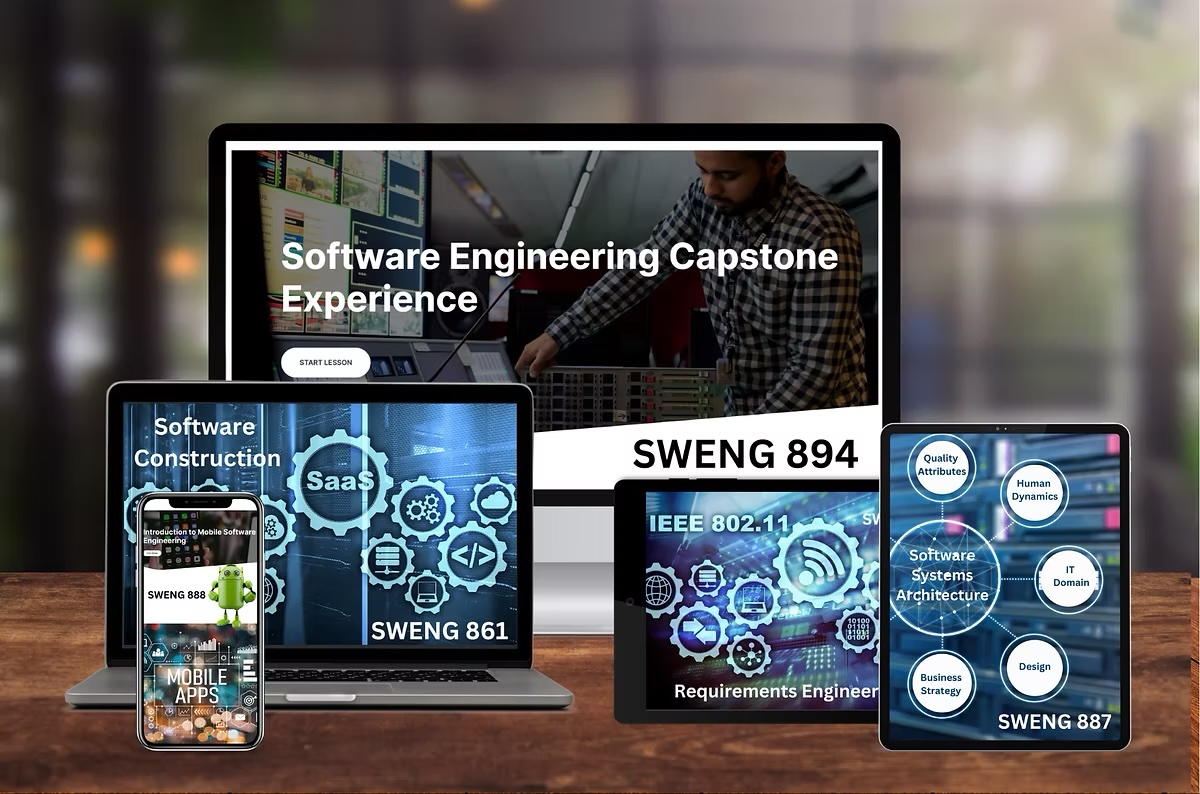
Multimedia development is a core competency for instructional designers, and this project exemplifies its impact through the comprehensive redesign of the graduate-level Software Engineering program for Penn State World Campus. The initiative integrated a range of innovative multimedia elements to enhance student engagement and improve the overall learning experience. Key features included the use of technical graphics, lightboard technology to showcase faculty, AI-generated voiceovers for instructor-agnostic video content, custom animations developed in Articulate, and a variety of other interactive assets. Together, these enhancements delivered a more dynamic, accessible, and user-centered educational experience for students in the program.
This project focused on the comprehensive redesign of the graduate-level Software Engineering program for Penn State World Campus, with the goal of enhancing student engagement and improving the overall learning experience. A primary challenge was the outdated nature of the program’s multimedia content, which lacked interactivity and relied heavily on instructor-centric videos. This made it difficult to update materials without re-recording and limited the program’s scalability. Additionally, the course lacked dynamic, engaging elements to support the complex concepts being taught.
To address these challenges, the instructional design team implemented a suite of innovative solutions. High-quality technical graphics were developed to visually explain complex software engineering principles. Lightboard technology was introduced to allow faculty to present content in a more engaging, personal format—writing and drawing while maintaining eye contact with students. AI-generated voiceovers were utilized to create instructor-agnostic video content, ensuring consistency across modules and allowing for easier content updates. Animations created in Articulate added interactivity and brought abstract processes to life, while a variety of other multimedia assets—such as simulations and scenario-based interactions—were incorporated to support different learning styles.
As a result of these efforts, the redesigned program saw a significant increase in student engagement and satisfaction. Learners responded positively to the modernized, interactive content, and faculty appreciated the flexible, easy-to-update design. The inclusion of diverse multimedia tools led to improved comprehension of key topics and higher performance on assessments. Overall, the redesign not only enhanced the learning experience for current students but also established a scalable, future-ready model for instructional delivery at Penn State World Campus.
Our team conducted a thorough analysis of the user experience (UX) and identified key pain points that were impacting the website’s performance. We redesigned the website with a focus on simplicity, ease of navigation, and mobile responsiveness. Key features included:
To help set the tone for SWENG 861, we developed a dynamic course introduction video that welcomes students, introduces key themes, and provides a clear roadmap for what to expect throughout the semester.
This module introduces key principles of User Experience (UX) Design within the context of software engineering. Students explore how thoughtful UX decisions directly impact software usability, user satisfaction, and overall product success. Through real-world examples and practical frameworks, the module emphasizes the importance of designing with the end user in mind—bridging the gap between technical functionality and intuitive design. It equips future engineers with the foundational knowledge needed to collaborate effectively with designers and prioritize user-centered thinking in the development process.
As part of the Software Engineering curriculum, we developed an interactive case study in Articulate Storyline that showcases expert analysis of a complex, real-world scenario. Designed to model industry best practices, the case study features guided walkthroughs of key decision points, where experienced professionals break down their reasoning and approach to solving common software engineering challenges.
